
Rain Gutter Installation in Sacramento: How to Protect Your Roof, Home & Foundation
Quick answer: For Sacramento homes, gutters are part of the roof’s water-management system. Properly sized and installed gutters collect runoff at the roof edge and move it through downspouts to a safe discharge point away from vulnerable areas of the home. Seamless aluminum is a practical choice for many local homes, but the best system depends on roof area, pitch, drainage layout, fascia condition, tree exposure, and the property itself.
A roof can be in excellent condition and still develop problems around the eaves if rainwater is not carried away correctly. That is why rain gutter installation should not be treated as a cosmetic finishing touch. Gutters, downspouts, roof edges, fascia, flashing, and site drainage all work together.
That matters in Sacramento because the region has a distinctly seasonal rainfall pattern. Sacramento County describes summers as generally dry and winters as moist, with average annual rainfall around 19 inches and more than half of yearly rainfall occurring during the November-through-February rainy season. Sacramento County climate data reinforces why a gutter system needs to be ready before the wet months arrive.
At Ark Roofing & Construction, we look at the roof and drainage system together. If you are replacing a roof, repairing fascia, or seeing water spill over the roofline during storms, it is worth evaluating the gutters at the same time.
Why Rain Gutters Matter for Sacramento Homes
Quick answer: Gutters help control where roof runoff goes. When they are missing, clogged, leaking, undersized, or pulling away from the fascia, water can repeatedly soak the roof edge and exterior surfaces or collect too close to the home.
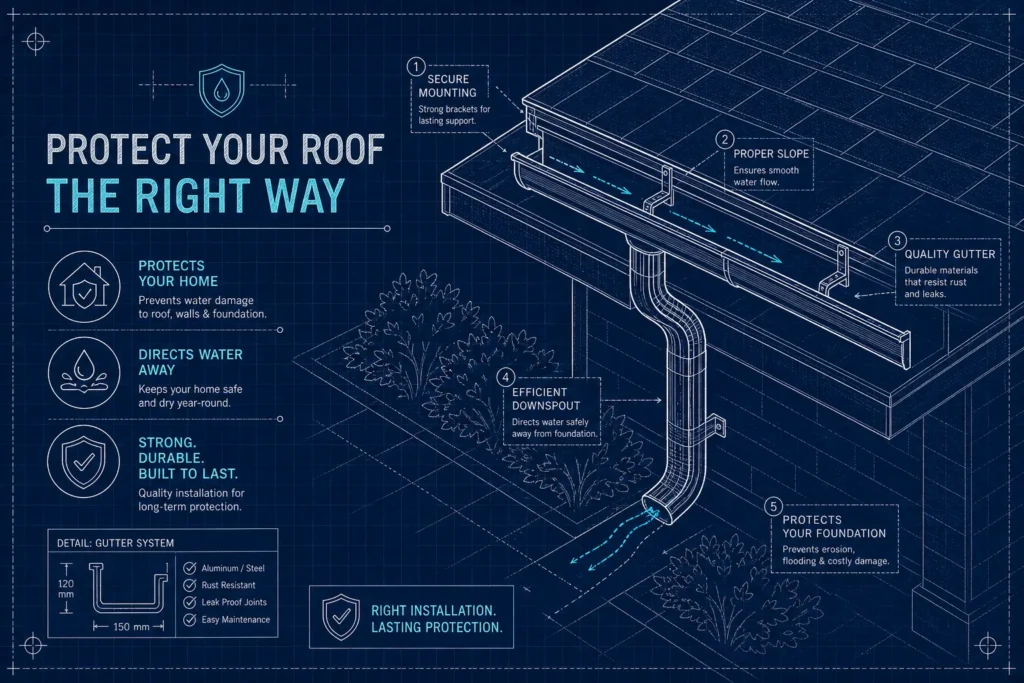
The basic job is simple: collect rainwater from the roof and move it to downspouts. FEMA describes downspouts as extensions of gutters that collect roof rainfall and direct runoff to the ground or drains. FEMA also recommends maintaining gutters and downspouts so roof water flows away from the home. FEMA flood-protection guidance emphasizes proper runoff and drainage around the building.
The damage often starts quietly at the roof edge
Gutter problems rarely begin with a dramatic interior leak. More often, homeowners notice smaller warning signs: staining below the gutter, peeling paint, water marks on fascia, overflowing corners, sagging runs, loose fasteners, or persistent pooling after a storm.
If the fascia is already soft or deteriorated, simply fastening a new gutter to it does not solve the underlying problem. The attachment surface should be evaluated first. This is one reason coordinating roofing, fascia work, and gutter installation can prevent one trade from covering up a problem the next trade needs to address.
What Type of Rain Gutters Are Best for Sacramento?
Quick answer: For many Sacramento homes, seamless aluminum K-style gutters offer a strong balance of drainage capacity, corrosion resistance, appearance, availability, and cost. The correct choice still depends on the roof and property.
K-style vs. half-round gutters
K-style gutters are common on residential homes because their shape provides useful capacity while fitting neatly against a conventional fascia board. Half-round gutters can be an attractive choice for homes where architectural character is a priority, but profile selection should consider both appearance and drainage needs.
Seamless vs. sectional gutters
Sectional gutters are assembled from shorter pieces, which creates joints along the run. Seamless gutters are formed in longer continuous sections, typically on-site, so the number of mid-run seams is reduced. Fewer seams mean fewer potential joint locations that may eventually require attention.
That does not make a seamless system maintenance-free. End caps, outlets, corners, downspout connections, hangers, and sealant still need to be installed correctly. The advantage is a cleaner continuous run with fewer joints.
Aluminum, steel, copper, or vinyl?
Aluminum is often the practical residential choice because it is lightweight and does not rust like unprotected ferrous metal. Steel offers strength and can be useful where durability is a priority. Copper is a premium architectural material with a distinctive appearance and higher cost. Vinyl is inexpensive, but material selection should account for long-term exposure to Sacramento heat, UV, and seasonal temperature changes.
For homes in wildfire-prone areas, material selection can involve another consideration: FEMA guidance identifies aluminum, galvanized steel, and copper as noncombustible gutter and downspout materials and discusses keeping combustible debris out of gutters. FEMA gutter and downspout wildfire guidance Home-specific recommendations should still account for local requirements and conditions.
How Much Does Rain Gutter Installation Cost in Sacramento?
Quick answer: There is no reliable per-home price based on square footage alone. Gutter cost is driven more directly by linear footage, material, number of stories, corners and rooflines, downspout count, access, fascia repairs, removal of old gutters, and whether the system is seamless.
What changes the price?
- Total linear feet of gutter and the number of separate runs
- Number, size, and placement of downspouts
- One-story versus two-story access
- Simple roof edges versus multiple corners and complex rooflines
- Condition of the fascia and whether damaged wood must be repaired first
- Material and profile selected
- Removal and disposal of an existing system
- Seamless fabrication and custom details
The best way to compare Sacramento gutter quotes is to compare scope, not just the bottom-line number. Ask what material and gauge are being used, how the system will be sized, where downspouts will discharge, whether fascia repairs are included, and exactly what is covered by the workmanship warranty.
How Are Gutters Properly Sized?
Quick answer: A new gutter system should be sized for the roof area it drains and local rainfall intensity. Copying the dimensions of an old gutter can repeat an existing sizing problem.
Professional sizing considers roof design area, gutter dimensions, run length, number of sections, and downspout configuration. SMACNA provides a Downspout & Gutter Sizing Calculator based on methods in its Architectural Sheet Metal Manual and notes that rainfall-intensity data can be entered for the local authority having jurisdiction.
A larger gutter is not automatically better, and adding downspouts randomly is not a substitute for planning. The objective is to create a continuous drainage path that can collect roof runoff and move it to appropriate discharge points without creating new water problems at grade.
Why downspout placement matters
A well-installed gutter can still perform poorly if its downspouts empty into the wrong place. Water should not simply be transferred from the roof to a spot where it repeatedly saturates a vulnerable area beside the home. The roof drainage plan should consider grading, walkways, landscaping, drainage features, and neighboring property.
Sacramento County notes that developed surfaces cause stormwater to move quickly into street gutters and drains, and its drainage resources emphasize responsible management of runoff. Sacramento County stormwater information The right discharge approach is property-specific.
What Does Professional Rain Gutter Installation Involve?
Quick answer: Professional installation is more than fastening a metal trough to the fascia. A complete job includes inspection, measurements, drainage planning, fascia evaluation, fabrication or cutting, secure attachment, outlet and downspout installation, sealing, and a final water-flow check.
1. Inspect the roof edge and fascia
Before new gutters are installed, the attachment area should be checked for deterioration, loose boards, damaged trim, or roof-edge conditions that need attention.
2. Measure each gutter run
Measurements determine linear footage, corners, end points, outlets, and downspout locations.
3. Plan drainage and sizing
The installer considers roof area, roof geometry, gutter profile, downspout locations, and where runoff will go after it leaves the downspout.
4. Fabricate or prepare the gutter
For seamless systems, long runs can be formed to fit the home, reducing mid-run joints.
5. Secure the system to sound material
Hangers and fasteners must be installed into appropriate supporting material. New gutters should not be used to hide deteriorated fascia.
6. Install outlets and downspouts
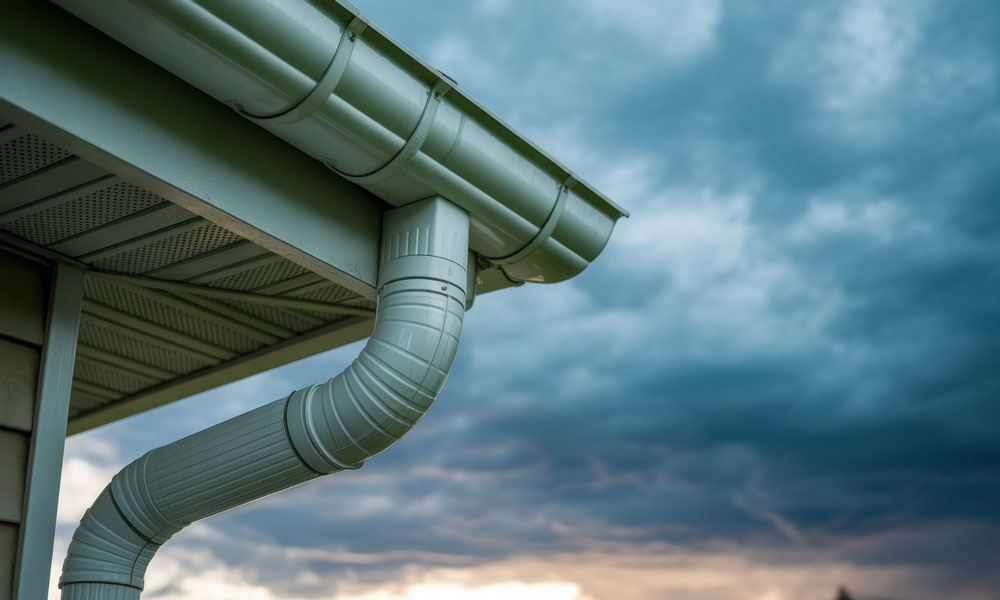
Downspouts are positioned to carry water away from the roofline and toward an appropriate drainage area.
7. Seal and test
Corners, outlets, end caps, and other necessary joints are sealed, then the system is checked for leaks, standing water, and drainage problems.
Should You Replace Gutters When You Replace the Roof?
Quick answer: Not always—but a roof replacement is one of the best times to inspect the gutters, fascia, roof edge, and drainage system together. If gutters are damaged, poorly sized, leaking, or attached to deteriorated fascia, addressing them during the roofing project can avoid duplicated work.
During a tear-off, the roof edge is accessible and conditions that were previously hidden may become visible. If fascia repair is needed, it can be completed before the new gutter is attached. Roofing and gutter details can also be coordinated instead of asking a second contractor to work around a newly finished roof.
If the existing gutters are relatively new, correctly sized, securely attached, and draining properly, replacement may not be necessary. A good contractor should inspect first rather than assume every roof needs a new gutter system.
Do You Need a Gutter Contractor or Can You DIY It?
Quick answer: Simple one-story sectional-gutter work may be within reach for an experienced homeowner, but professional installation becomes more valuable when the home is two stories, fascia repairs are needed, the roofline is complex, or seamless fabrication and drainage planning are involved.
Common installation errors include mounting gutters to deteriorated fascia, creating low spots that hold water, poorly sealing joints, insufficient support, and placing downspouts where they create a new drainage problem.
Safety matters too. Working from ladders around roof edges is not a good place to learn by trial and error. If access is difficult or the project involves roof-edge repair, professional installation is generally the more sensible path.
How to Choose a Rain Gutter Installation Company in Sacramento
Quick answer: Look beyond the lowest quote. A reputable gutter contractor should be able to explain material, sizing, fascia condition, attachment, downspout placement, project scope, cleanup, and warranty in plain language.
- Ask whether the estimate specifies the gutter material and profile.
- Confirm whether the proposed system is seamless or sectional.
- Ask how the contractor determines gutter and downspout sizing.
- Have the fascia inspected before installation.
- Ask where each downspout will discharge.
- Get repairs, removal, installation, and cleanup clearly described in writing.
- Review contractor licensing, insurance, local reputation, and workmanship coverage.
- Compare the actual scope of competing quotes—not just the total price.
A lower bid can be more expensive in the long run if it excludes fascia repair, uses an undersized drainage layout, or leaves you coordinating another contractor to finish the roof edge.
Rain Gutter Replacement: Signs It May Be Time
Quick answer: Consider an inspection if gutters repeatedly overflow, sag, pull away from the fascia, leak at multiple joints, hold standing water, show widespread corrosion or damage, or no longer direct water where it needs to go.
One isolated leak does not necessarily mean the entire system needs replacement. Repairs may make sense when the gutters are otherwise sound. Replacement becomes more compelling when problems are widespread, the layout is inadequate, or the existing system is being removed as part of roof and fascia work.
If you are unsure, have the system evaluated during dry weather rather than waiting for the first major winter storm to reveal the weak points.
Sacramento Rain Gutter Installation FAQs
What is the average cost to install rain gutters in Sacramento?
The price depends on linear footage, material, stories, roof complexity, downspouts, access, fascia condition, and whether the gutters are seamless. Broad national/California planning ranges can help with budgeting, but a Sacramento home should be measured and inspected for an accurate quote.
How much do gutters cost on a 1,500-square-foot house?
Square footage alone cannot determine gutter cost because gutters follow the roof perimeter and drainage layout, not the interior floor area. A compact two-story home and a wide single-story home with the same living area may need very different gutter footage.
How much does 100 feet of gutter cost?
The answer varies by material and project conditions. The source article cites broad 2026 installed planning ranges of roughly $6-$12 per linear foot for aluminum, $8-$14 for steel, and $18-$35 for copper. Local labor, seamless fabrication, stories, corners, removal, fascia work, and downspouts can change the final price.
Are seamless gutters worth it?
For many homeowners, yes. Seamless gutters reduce the number of joints along straight runs, which means fewer potential leak points and a cleaner appearance. Corners, outlets, end caps, and downspout connections still require proper installation and maintenance.
What gutter material is best for Sacramento weather?
Aluminum is a practical choice for many Sacramento homes because it is lightweight and corrosion-resistant. Steel and copper can also be appropriate depending on durability, architecture, budget, and project requirements.
How often should gutters be replaced?
There is no single replacement schedule that fits every home. Material, installation quality, tree exposure, maintenance, corrosion, physical damage, and fascia condition all affect service life. Condition and performance are more useful than age alone when deciding whether to repair or replace.
Do new gutters add value to a home?
A functioning gutter system is primarily a protection and maintenance improvement. It can improve exterior appearance and reassure buyers that roof runoff is being managed, but the financial return varies by property and market.
Should gutters be installed before or after a new roof?
The work should be coordinated with the roofing contractor. In many roof-replacement projects, inspecting and repairing fascia first and coordinating gutter installation with the finished roof edge produces the cleanest sequence.
Can Ark Roofing install gutters as part of a roof replacement?
Ark Roofing & Construction can evaluate the roof, roof edge, fascia, and rain gutter needs as one exterior project so homeowners do not have to treat drainage as an afterthought.
How do I get a rain gutter installation estimate in Sacramento?
Schedule an inspection so the home can be measured and the roofline, fascia, drainage needs, downspout locations, access, and material options can be evaluated before a written scope is prepared.
Protect the Roof by Managing the Water
A rain gutter system is easy to overlook because most of it sits quietly at the edge of the roof. Its job becomes obvious only when something goes wrong. In Sacramento’s dry months, a sagging run or poor downspout location may seem harmless. During the winter rainy season, the same weakness can send water over the fascia or toward an area where it does not belong.
The best time to solve that problem is before the storm.
If you are planning a roof replacement, seeing signs of fascia damage, or considering new rain gutters in Sacramento, request a rain gutter installation estimate from Ark Roofing & Construction. We can evaluate the roof and drainage system together and provide a clear written scope for the work your home actually needs.
Leave a Reply